42mm or 50mm Screws for DryBloc® TG4? What Fixing Length Do You Need?

Does a Longer Screw Mean a Stronger Floor? "Bigger Isn't always better"
When installing 22mm DryBloc® TG4 flooring onto timber joists, one of the questions we are sometimes asked is whether a 42mm screw is long enough, or whether a 50mm screw should be used instead.
It is a reasonable question. After all, a longer screw provides more penetration into the timber. But does that necessarily make it a better fixing?
In a flooring application, not necessarily.
Is a 42mm screw suitable for 22mm DryBloc® TG4?
Yes. A 42mm CEMBLOC® screw is suitable for fixing DryBloc® TG4/22 to timber floor joists.
With a 22mm board, a 42mm screw provides approximately 20–21mm of penetration into the timber joist. This provides sufficient embedment for the intended purpose of the fixing: securely restraining the floor board and preventing movement.
A 50mm screw would provide approximately 28mm of penetration into the timber.
While this is deeper, the additional 7–8mm of penetration does not provide a meaningful advantage for the intended flooring application once sufficient fixing depth has already been achieved. Or does it?
Does a longer screw mean a stronger floor?
Not necessarily.
It is easy to assume that a 50mm screw must be better simply because it is longer. However, screw length is only one part of an effective fixing system.
Once the screw has sufficient penetration into the timber, increasing the length further provides diminishing returns. For a floor board, what is particularly important is how the board is restrained across its surface.
The number and spacing of the fixings therefore play an important role in controlling movement.
An analogy we like to use is securing a tent.
One very long peg is not necessarily more effective than several appropriately positioned pegs. Once a peg has sufficient penetration into the ground, making it significantly longer does not necessarily make the tent more secure. It is the number and positioning of the fixing points that help prevent movement across the whole tent.
The same principle can be applied to a floor board.
A correctly positioned series of suitable fixings provides restraint across the board, rather than relying on a small number of deeper fixings.
What about movement and squeaking?
For flooring, the objective of the screws is primarily to secure the DryBloc® to the timber and prevent movement.
The fixing arrangement is therefore important. Appropriate screw spacing ensures that the board is adequately restrained across the joists rather than being held firmly only at isolated points.
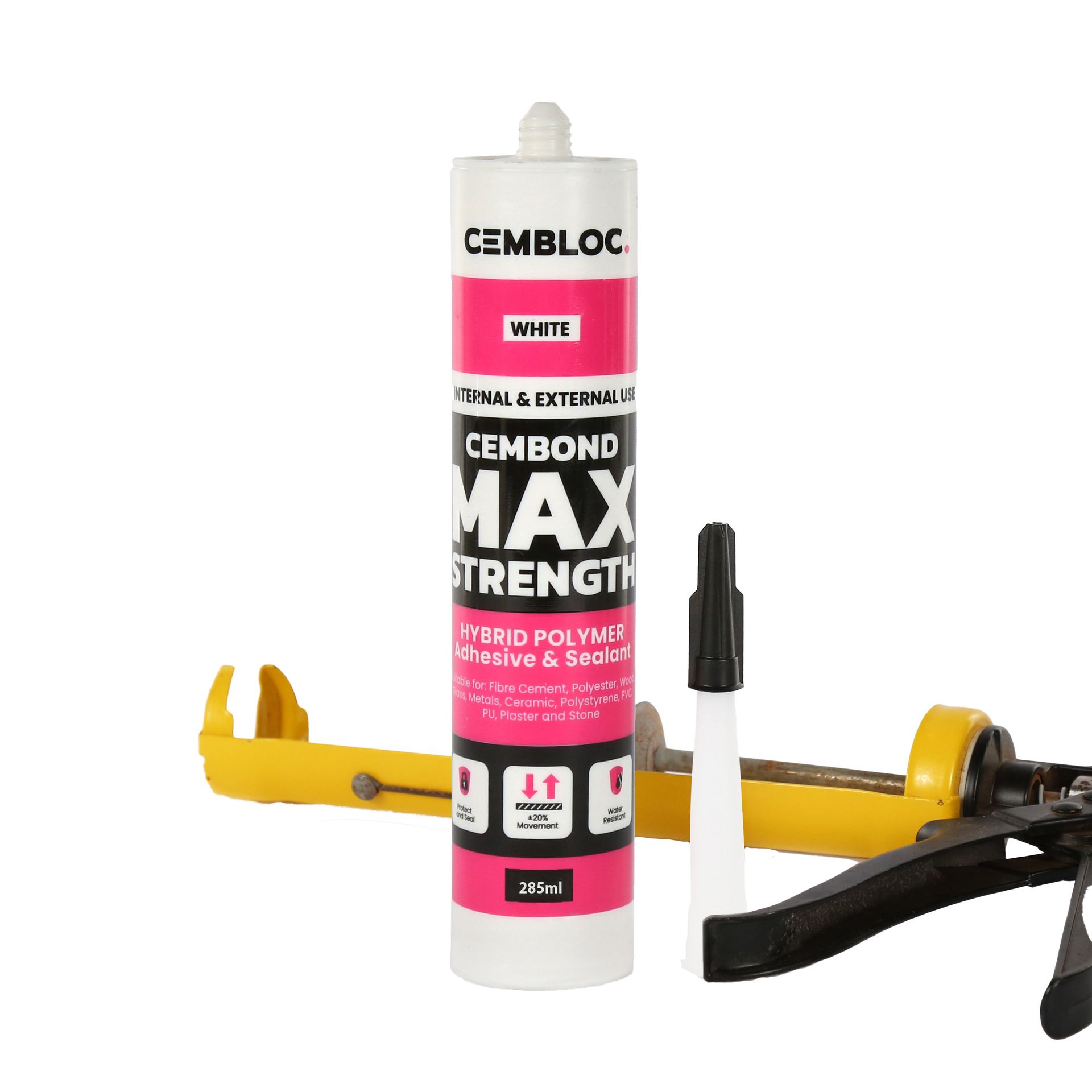
This is also why we recommend using a secondary fixing with CEMBLOC® Max Strength Adhesive.
Why use CEMBLOC® Max Strength Adhesive?
CEMBLOC® Max Strength Adhesive is a high-performance hybrid polymer adhesive designed to provide additional bonding between the DryBloc® board and the supporting timber.
Used alongside mechanical fixings, the adhesive provides a continuous bond between the board and joist rather than relying solely on individual screw fixing points.
This can help:
- Reduce movement between the board and joist
- Provide additional support across the board
- Distribute restraint more continuously across the joist-to-board interface
- Improve the overall stability of the flooring installation
The result is a fixing system that combines mechanical restraint from the screws with additional continuous bonding from the adhesive.
The key point is that the 42mm screw already provides adequate penetration into the timber joist.
Choosing a longer screw does not automatically result in a better flooring installation. Once adequate penetration has been achieved, correct fixing quantity, spacing and the use of the recommended adhesive become more important considerations
Our recommended approach
For DryBloc® TG4/22 installed over timber floor joists, the recommended approach is to use:
CEMBLOC® 42mm screws + CEMBLOC® Max Strength Adhesive
The screws provide the necessary mechanical restraint, while the hybrid polymer adhesive provides additional bonding and support between the DryBloc® and timber.
In summary
If you are looking at purchasing our 22mm DryBloc® TG4 together with CEMBLOC® 42mm screws, there is no need to replace them simply because a longer 50mm screw may appear to offer greater penetration.
The 42mm fixing provides approximately 20–21mm of penetration into the timber, which is adequate for securing the board and preventing movement.
Rather than simply increasing screw length, attention should be given to the number and spacing of fixings, together with the use of CEMBLOC® Max Strength Adhesive as a secondary fixing.
"Bigger isn't always better" — once you have sufficient penetration, how you fix the board matters more than simply adding extra screw length.